Precision Chiropractic West · West Des Moines, IA
Craniocervical Instability in Des Moines: Care for the Patients Nobody Could Explain
A destination practice for complex CCI — measured, gentle, and built on seeing what static imaging cannot.
If you’re searching for help with craniocervical instability in Des Moines, you have probably already done something most patients never have to do: convince people you are actually sick.
You know the strange, shifting catalog of symptoms that makes CCI so hard to describe. The dizziness that comes in waves. The brain fog that swallows words mid-sentence. The feeling that your head is too heavy for your neck to carry — that you have to hold it up on purpose. The buzzing, the tingling, the visual weirdness you’ve stopped mentioning because of the looks it gets. Good days you don’t trust, and crashes that arrive without warning.
And you know the sentence that has defined this whole ordeal: “Your MRI is normal.” You’ve heard it from doctors who were kind and doctors who were dismissive, and it always lands the same way — because your life is not normal. Somewhere along the line, someone probably suggested it was stress. Anxiety. All in your head. And you began doing your own research at midnight, because no one else was doing it for you.
What Craniocervical Instability Actually Is — and Why Your “Normal” MRI Missed It
The junction where your skull meets your spine is unlike anywhere else in your body. There is no disc between the skull and the atlas — the topmost vertebra — or between the atlas and the vertebra below it. Everything at that junction is held together by ligaments alone: a two-ounce ring of bone carrying a nine-to-seventeen-pound head, stabilized entirely by soft tissue. That design gives your neck extraordinary mobility. It also means that when those ligaments are stretched or damaged — by whiplash, a fall, a concussion, or connective tissue laxity — the head and atlas can move beyond their safe range. That is craniocervical instability: not a broken bone, but a compromised anchoring system.
Now consider what lives at that crowded junction. The brainstem passes through it. The vertebral arteries make their sharp final turn there before entering the skull. The pathways that drain fluid from the cranium run through the same narrow space. When the anchoring system that protects all of it becomes unstable, the possible symptoms are as varied as the structures involved — which is exactly why CCI patients present with such a bewildering, shifting mix, and why it so rarely fits neatly into any one doctor’s territory. We assess that junction — its alignment, its stability, its motion — structure by structure.
And here is why the scans keep coming back “normal”: instability is a problem of motion, and an MRI is a picture of stillness. A standard MRI is taken while you lie flat, your head supported and at rest — the one position in which an unstable joint is under the least demand. The ligaments aren’t being asked to do anything, so their failure doesn’t show. Your scan wasn’t wrong. It was asked the wrong question.
Seeing It: Motion Imaging Through DMX of Iowa
Because CCI is fundamentally a ligament problem, and ligament problems show themselves in motion, complex cases like these are exactly what motion imaging exists for. This practice houses DMX of Iowa — the only Digital Motion X-Ray provider in the state. DMX captures live, video X-ray of your neck while it actually moves, making it possible to see how the bones travel through their range — and where the anchoring system is failing to hold them. For patients who have spent years being told nothing is wrong, seeing the problem move on a screen is often the single most validating moment of their entire medical journey. It is objective, visual evidence — obtained before any correction is made.
The Doctor Trained for the Cases That Are Too Delicate to Guess On
CCI care carries a responsibility most conditions don’t: an unstable upper cervical spine must never be handled carelessly. This is where Dr. Griffin’s training matters most.
Precision Chiropractic West is led by Dr. Laurel Griffin, DC, BCAO. She holds the rare Board Certification in the Atlas Orthogonal Technique (BCAO), earned in 2006 — a distinction shared by only roughly 375 doctors worldwide. She trained directly under Dr. Roy W. Sweat, the founder of the Atlas Orthogonal technique, and spent years in advanced, one-on-one mentorship with Dr. Scott Rosa, a leading figure in the management of the most complex upper-cervical and CCI cases — building a depth of experience and training that very few chiropractors anywhere can match. Her post-graduate training spans five critical, high-stakes areas most general practices never touch:
For CCI, the one that matters most is risk management — knowing exactly when it is safe to adjust, how to proceed when stability is fragile, and, most importantly, when not to touch the spine at all. For a CCI patient, that judgment is not a nicety. It is the difference between healing and harm — and it is the precise subject Dr. Griffin teaches. She actively mentors and trains other Atlas Orthogonal doctors across the country in risk management and complex case handling, and other doctors — including other AO practitioners — refer the cases they cannot safely manage to her. When you place a fragile neck in her hands, you are placing it with the teacher.
The Treatment: Measured, Gentle, and Aimed at Stability
The goal of care here is not temporary relief. It is stability — restoring alignment so the ligaments are finally in a position to heal.
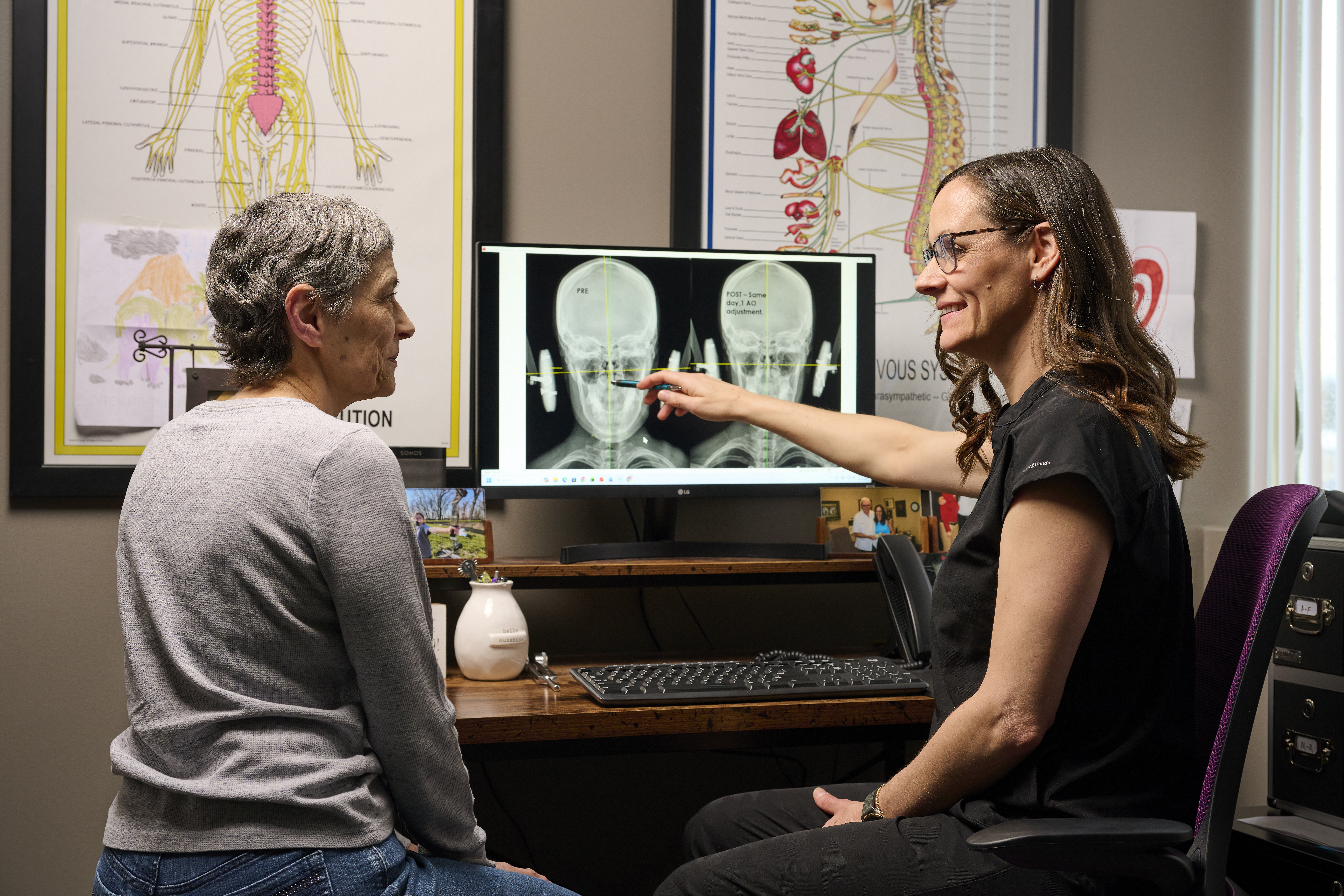
For a patient with an unstable upper cervical spine, forceful manual manipulation is exactly the wrong tool. Atlas Orthogonal involves none of it. The AO percussion instrument delivers a gentle, mechanical percussive wave through a stylus placed just behind the ear: three to six pounds of force, no twisting of the head, no thrust, no cracking. Most patients feel almost nothing. Every correction is calculated from your imaging — a five-view X-ray protocol from which Dr. Griffin measures the exact angle and direction of misalignment in degrees, then sets the instrument to deliver force along that precise vector. If you have had a DMX or other prior imaging, findings from those studies are factored into your analysis as well. After your first correction, imaging is repeated and compared to confirm the bone actually moved. We don’t guess, and we don’t take your word for it. We confirm.
Checked, not adjusted. At every visit, your alignment is measured first. If it is holding, no adjustment is given — because every unnecessary correction is unnecessary force on ligaments that are trying to heal. The entire aim is for your body to hold correct position for longer and longer stretches. For a CCI patient, holding is the therapy. Here, your care plan is dictated solely by your clinical needs — nothing else.
A Destination Practice for a Condition Few Are Trained to Manage
Craniocervical instability rarely has a local answer. Patients come to this West Des Moines practice from across Iowa and surrounding states including Missouri, Nebraska, Wisconsin, and Illinois, and fly in from farther still — because the combination this condition demands is genuinely rare: advanced training in complex upper-cervical management, the judgment to know when not to act, and the only motion imaging center in the state, all under one roof. If you have been managing this alone, you no longer have to.
What We’re Working Toward, Together
An answer you can see. For most CCI patients, the first goal is the one that has been denied them the longest: objective, visual evidence of what is actually happening at the top of their spine — and a doctor who takes it seriously.
A plan built on measurement. Care calculated from imaging, in degrees — adjusted only when needed, confirmed when done.
Stability, step by step. Recovering from CCI is a marathon, not a sprint. The aim of every visit is the same: help your body hold its correct position a little longer, so the ligaments have the chance to heal.
Schedule Your Consultation
If you suspect craniocervical instability — or you’ve been carrying a diagnosis no one seems equipped to manage — the next step is a consultation. We will review your history, your imaging, and your symptoms, determine whether motion imaging is warranted in your case, and tell you honestly whether you are a candidate for Atlas Orthogonal care. If we are not the right fit for your case, we will tell you that too.
Living with Craniocervical Instability in Des Moines?
Schedule a consultation to have the top of your spine carefully assessed — and to find out whether motion imaging and Atlas Orthogonal care are right for your case.
Schedule Your Consultation

Dr. Laurel Griffin, DC, BCAO
Board Certified in the Atlas Orthogonal Technique since 2006, Dr. Griffin is one of roughly 375 doctors worldwide to hold the BCAO distinction. She trained under Dr. Roy W. Sweat, the founder of Atlas Orthogonal, and refined her work through years of advanced, one-on-one mentorship with Dr. Scott Rosa in the management of the most complex upper-cervical and CCI cases. Her extensive post-graduate training spans head/neck trauma, advanced imaging, advanced biomechanics, risk management, and complex case management — making her one of the most extensively trained doctors in the management of complex upper-cervical and CCI cases anywhere, and the doctor other Atlas Orthogonal practitioners turn to for the cases they cannot safely manage. A native Iowan who returned home to serve patients across the Des Moines metro and the surrounding region, Dr. Griffin also draws on her own experience overcoming debilitating health conditions through Atlas Orthogonal care.