Migraine Headaches in Des Moines: When the Cause Is in Your Neck, Not Your Head
A precise, corrective approach for the chronic migraine cases other treatments have failed — led by a doctor who has lived them herself.
If you’re searching for help with migraine headaches in Des Moines, you don’t need anyone to tell you what a migraine is. You know the early warning — the aura, the wrong kind of light, the tightness climbing the back of your skull — and the sinking arithmetic of what has to be canceled this time. You know the dark bedroom in the middle of the afternoon while your family’s life goes on without you downstairs. You know the guilt of the birthday party you left early, the deadline you pushed, the vacation you spent in the hotel room.
Migraines don’t just take days — they take the days in between, too. You live scanning for triggers, planning around a body you can’t trust, carrying the quiet dread of the next attack. When the pain is this frequent and this consuming, it stops being a symptom you have. It becomes a schedule you live under.
You’ve Managed the Symptoms. Nobody Has Found the Cause.
By the time most migraine patients find us, they’ve become reluctant experts. The preventives and the abortives — and the careful rationing so the treatment doesn’t become its own trigger. The elimination diets and the headache journals. The blue-light glasses, the supplements, the injections. The MRI or CT that came back “normal.” The specialists’ offices that ended with a new prescription and the same unanswered question: why is this happening to me?
If that sounds familiar, hear this clearly: you are not imagining your pain, and you are not out of options. For many chronic migraine sufferers, one structure has never been carefully examined: the top of the neck.
The Question Nobody Asked: What If It’s Your Neck?
The top of your neck sits closer to the machinery of head pain than most people ever realize. When a new migraine patient comes to Precision Chiropractic West, there are three things Dr. Griffin assesses — three ways the upper cervical spine and the head are anatomically intertwined:
- The brainstem connection. The nerve center that processes pain from your head and face — the trigeminal nucleus — doesn’t stop at the skull. It extends down into the upper cervical spinal cord, directly alongside the top vertebrae. This is the anatomical reason neck problems and head pain are so often entangled: irritation at the top of the neck can feed directly into the system that registers head and facial pain. We assess for exactly this.
- Blood flow at the sharp turn. The vertebral arteries — a major blood supply to the brain — make a sharp turn at the atlas, the topmost vertebra, just before entering the skull. The alignment of that one bone matters to the geometry those arteries must navigate. We look at it.
- Drainage from the cranium. Fluid has to leave your head as reliably as it arrives, and the pathways it uses run through the same crowded junction at the top of the neck. Impaired drainage is one more way this small region may contribute to head pressure and pain. We assess this as well.
There’s one more pattern worth naming, because it describes so many of our patients: the old injury. A car accident in your twenties. A concussion from sports. A fall you walked away from. The head healed and everyone moved on — but a concussion almost always involves a neck injury too, and the neck’s share of the damage is routinely overlooked. There is no disc between your skull and the atlas, or between the atlas and the vertebra below; that region is held together by ligaments alone. When trauma stretches those ligaments, the atlas can lock into a misaligned position — and years later, the migraines arrive without an obvious cause. The scans of your head come back normal, because the problem was never in your head.
The Doctor Trained for the Cases Everyone Else Ran Out of Answers For
Precision Chiropractic West is led by Dr. Laurel Griffin, DC, BCAO. She holds the rare Board Certification in the Atlas Orthogonal Technique (BCAO), earned in 2006 — a distinction shared by only roughly 375 doctors worldwide. And the certification is where her training begins, not where it ends.
Dr. Griffin trained directly under Dr. Roy W. Sweat, the founder of the Atlas Orthogonal technique, and refined her work through years of advanced, one-on-one mentorship in the management of the most complex upper-cervical cases — building a depth of experience and training that very few chiropractors anywhere can match. Her post-graduate training goes beyond the standard Atlas Orthogonal curriculum, spanning five critical, high-stakes areas most general practices never touch — and it has been refined through years of in-depth, one-on-one training with Dr. Scott Rosa:
Head & neck trauma · Advanced imaging · Advanced biomechanics · Risk management · Complex case management
And she doesn’t just practice these methods — she teaches them. Dr. Griffin actively mentors and trains other Atlas Orthogonal doctors in risk management and the handling of complex cases. The chronic, intractable migraine cases — the ones that have defied every conventional approach — are precisely what her training was built for. When you bring her your case, you are bringing it to the teacher.
She Has Sat Where You’re Sitting
Dr. Griffin doesn’t understand chronic migraines from a textbook. She lived them — debilitating migraines, alongside fibromyalgia, severe enough to reshape her own life. It was Atlas Orthogonal care that changed her story, and it’s why she turned down opportunities elsewhere to come home to Iowa and build a practice around this work.
That is her story, and every patient’s case is their own. But it means something to sit across from a doctor who has personally been on your side of the desk — who knows what it is to cancel the things that matter, and who takes your pain seriously because she has carried it. That experience is in the room at every consultation.
Measured in Degrees, Confirmed by Imaging
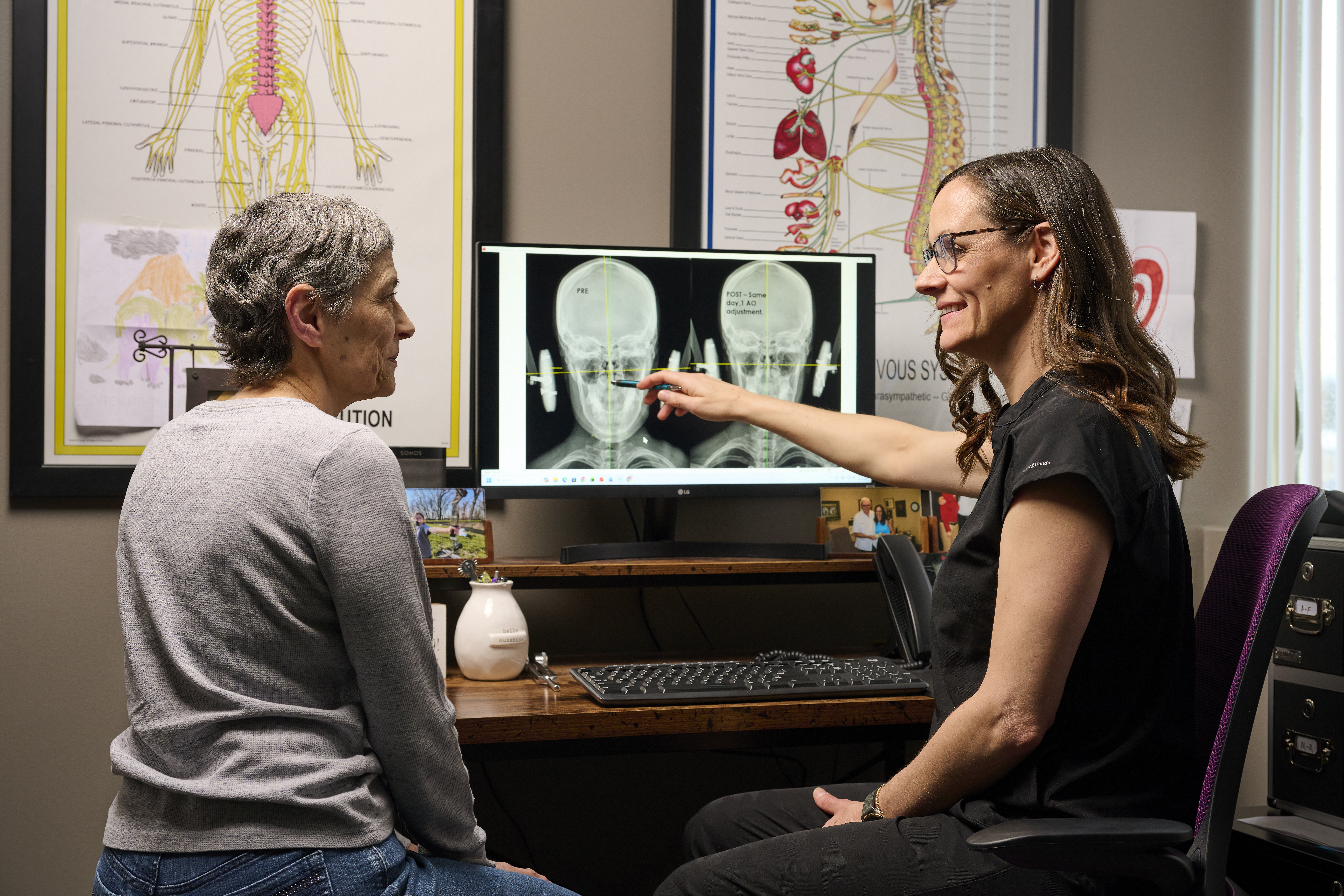
Precise correction begins with a precise diagnosis. A standard examination here uses a three-view X-ray protocol from which Dr. Griffin calculates the exact angle and direction of your misalignment — in degrees — then sets the instrument to deliver its correction along that precise vector. After your first correction, imaging is repeated and compared to confirm the bone actually moved into position. Success is not judged by asking how you feel in the moment. We don’t guess — and we don’t take your word for it. We confirm.
Correction, not management. At each visit you are checked — not automatically adjusted. If your alignment is holding, no adjustment is given, because the goal is for your body to hold its correct position for longer and longer stretches so the underlying structure can heal. Our aim is not to manage your symptoms indefinitely. It is to correct the structural problem we can measure.
For Complex and Trauma Cases: Motion Imaging Through DMX of Iowa
For patients whose migraines trace back to an auto accident, a concussion, or other trauma — and whose static scans keep coming back “normal” — Dr. Griffin can draw on a tool no other clinic in the state offers: DMX of Iowa, the only Digital Motion X-Ray provider in Iowa. DMX captures real-time, video X-ray of the spine in actual movement, revealing the ligamentous instability that static imaging misses — the kind of injury that hides in stillness and shows itself in motion.
Important: DMX is not part of every visit. It is reserved for the complex, critical, and trauma-related cases where motion imaging genuinely changes the diagnosis or the treatment plan. When it’s warranted, it gives us objective, visual proof of the problem before any correction is made.
Gentle Enough for a Head That Hurts
If you live with migraines, the idea of someone twisting and cracking your neck may be unthinkable — and it should be. Atlas Orthogonal involves none of it. The AO percussion instrument delivers a gentle percussive wave through a stylus placed just behind the ear: three to six pounds of force, no twisting of the head, no thrust, no cracking sound. Most patients feel almost nothing. The upper cervical spine protects the delicate neurovascular structures at the base of the skull — the very structures involved in the three pathways above — and it deserves exactly this kind of precision.
Knowing when not to adjust. Because of her advanced training in trauma and risk management, Dr. Griffin knows exactly when to adjust — and, just as importantly, when not to. For a patient whose stability is fragile, that judgment is the difference between healing and harm. Here, your care plan is dictated solely by your clinical needs — nothing else.
Schedule Your Consultation
If you’re ready to have the top of your neck carefully examined — possibly for the first time — the next step is a consultation. We will review your history, your imaging, and your symptoms, and tell you honestly whether the upper cervical spine appears to be involved and whether you are a candidate for Atlas Orthogonal care. If it isn’t, we will tell you that too.
Ready to Find Out Whether Your Migraines Start in Your Neck?
Schedule a consultation to determine whether the upper cervical spine is involved — and whether you are a candidate for Atlas Orthogonal care.
Call (515) 224-1093Schedule Your Consultation

Dr. Laurel Griffin, DC, BCAO
Board Certified in the Atlas Orthogonal Technique since 2006, Dr. Griffin is one of roughly 375 doctors worldwide to hold the BCAO distinction. She trained under Dr. Roy W. Sweat, the founder of Atlas Orthogonal, and refined her work through years of advanced, one-on-one mentorship with Dr. Scott Rosa in the management of the most complex upper-cervical and CCI cases. Her extensive post-graduate training spans head/neck trauma, advanced imaging, advanced biomechanics, risk management, and complex case management — making her one of the most extensively trained doctors in the management of complex upper-cervical cases anywhere. A native Iowan who returned home to serve patients across the Des Moines metro and the surrounding region, Dr. Griffin personally overcame debilitating migraines and fibromyalgia through Atlas Orthogonal care — the experience that shaped her practice.